
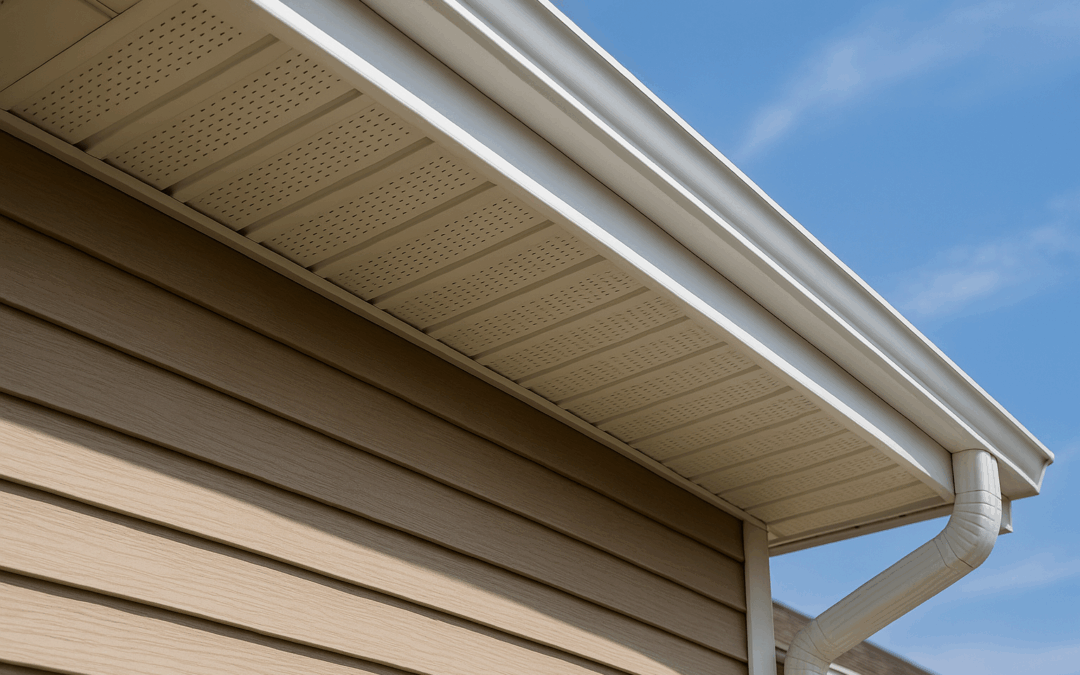
Cincinnati, Ohio homeowners evaluating options for soffit replacement or new roofline construction frequently consider vinyl soffit as a material offering distinct performance advantages over traditional wood soffit. The underside of the roof overhang—the soffit area enclosed between the exterior wall and the fascia board—performs important functions including attic ventilation and pest exclusion while facing sustained exposure to Cincinnati’s demanding four-season climate. Gutters Etcetera recognizes that Cincinnati-area homeowners benefit from a thorough, detailed understanding of vinyl soffit—what it is, how installation proceeds, what advantages it provides in Cincinnati’s specific climate conditions, and what practical considerations homeowners should understand when evaluating this material for their homes.
Understanding Vinyl Soffit
Vinyl soffit consists of panels formed from polyvinyl chloride (PVC) engineered for installation on the underside of roof overhangs. Available in both solid panel configurations for enclosed areas where ventilation is not required and perforated or vented panel configurations that allow outside air entry into the attic space, vinyl soffit panels are produced in a range of profiles and colors—most commonly whites and neutral tones designed to coordinate with complementary vinyl exterior products including siding, fascia wrap, and trim.
Unlike wood soffit, whose moisture protection and appearance depend on applied surface coatings that require periodic renewal, vinyl soffit’s color is integrated throughout the PVC material during manufacturing. This manufacturing characteristic means the product does not require field painting to maintain either its appearance or its resistance to moisture—properties that distinguish it fundamentally from wood in terms of long-term maintenance requirements.
The installation system uses channel trim pieces—J-channel or F-channel—at the wall face and fascia board to create receiving tracks for panel edges. Panels interlock along their long edges, with face-nailing through nailing hems securing each panel to soffit framing while adjacent panels’ interlocking edges conceal the fasteners. This system produces a clean, uniform finished surface while accommodating the thermal expansion and contraction that Cincinnati’s pronounced seasonal temperature range produces in PVC materials.
Cincinnati’s Climate Context for Soffit Material Selection
Cincinnati’s humid continental climate subjects exterior building materials to a comprehensive and demanding range of weathering conditions across four pronounced seasons. Annual precipitation of approximately 42 inches, high Ohio Valley humidity throughout warmer months, regular winter freeze-thaw cycling, spring thunderstorm seasons delivering intense rainfall, and summer heat and UV intensity combine to create year-round deterioration pressure on exterior materials.
Wood soffit in Cincinnati’s climate follows a predictable deterioration trajectory. Ohio Valley humidity maintains elevated wood moisture content between rainfall events, supporting fungal activity over extended periods following each rain. Spring and summer rainfall provides repeated direct moisture loading. Winter freeze-thaw cycling cracks paint films through repeated substrate dimensional cycling, progressively exposing larger wood areas to direct moisture contact. UV intensity during Cincinnati’s summers degrades exterior paint, accelerating protective coating failure. The mixed hardwood forests surrounding Cincinnati’s neighborhoods contribute heavy gutter debris loads that cause overflow events directing concentrated moisture against soffit repeatedly.
The consequence is wood soffit requiring repainting every few years, developing rot within a decade without attentive maintenance in Cincinnati’s conditions, and creating ongoing maintenance demands that vinyl soffit’s material properties substantially reduce.
How Vinyl Soffit Is Installed in Cincinnati Homes
Installation quality begins with thorough substrate preparation. In replacement projects, existing deteriorated wood soffit is removed completely and the underlying framing—nailer boards, lookout framing, or rafter tails supporting the soffit system—is inspected for moisture damage, pest damage, and structural integrity. Addressing any compromised framing before installing new soffit is essential: covering deteriorated framing with new vinyl panels conceals ongoing structural damage without resolving it, producing poor long-term outcomes.
Channel trim installation requires precision. J-channel or F-channel pieces installed along the wall face and along the fascia board must be level, consistently positioned, and securely fastened to provide the geometry that all soffit panels must fit. Channel pieces that are not level or that are positioned inconsistently produce finished soffit with visible irregularities that no amount of panel adjustment can correct after channel installation.
Panel cutting and installation proceeds from one end of each soffit run, with panels measured to span precisely between wall channel and fascia channel, then inserted and interlocked as each successive panel is added. Panels are face-nailed to soffit framing through nailing hems, with the interlocking edge of each subsequent panel covering the previous panel’s fasteners. Throughout installation, panels must be installed with appropriate clearance in their channels—not cut tightly or forced into binding channels—to allow the thermal movement that Cincinnati’s temperature range demands. Summer attic temperatures can heat soffit panels substantially above ambient air temperatures, and installations without adequate thermal expansion allowance develop buckling and distortion.
Vented panel planning requires specific attention for Cincinnati homes. Attic ventilation requirements based on conditioned floor area and roof pitch determine minimum net free ventilation area. Vented vinyl soffit panels provide consistent and measurable ventilation area per linear foot, allowing installers to calculate and achieve appropriate ventilation area through deliberate panel placement. Homes in Cincinnati’s neighborhoods surrounded by mature mixed hardwood trees should ensure that soffit vents are positioned and maintained to prevent debris intrusion that reduces effective ventilation area over time.
What Vinyl Soffit Offers Cincinnati Homeowners
Complete Moisture Non-Absorption: The defining advantage of vinyl over wood for Cincinnati’s climate is that PVC does not absorb water. Vinyl panels that receive moisture from gutter overflow, wind-driven rain, or condensation shed that moisture from their surface without retaining it in the material. This eliminates the sustained elevated moisture conditions that support wood-decaying biological activity—the fundamental deterioration mechanism that makes wood soffit maintenance-demanding in Cincinnati’s humid Ohio Valley environment.
Permanent Freedom from Repainting: Vinyl soffit’s factory-integrated color provides permanent appearance without field painting. In Cincinnati’s climate where wood soffit painting cycles must repeat every few years to maintain moisture protection effectiveness, eliminating this recurring maintenance requirement represents substantial long-term savings in cost, labor, and disruption.
No Susceptibility to Wood-Boring Insects: Carpenter bees, which bore circular entry holes in wood soffit for nesting galleries, cannot damage vinyl panels. This resistance eliminates a deterioration pathway that warm-season insect activity maintains persistently in Cincinnati’s climate.
Freeze-Thaw Performance: Vinyl soffit properly installed with thermal expansion accommodation performs reliably through Cincinnati’s repeated winter freeze-thaw cycles. Unlike painted wood, whose paint film cracks progressively through thermal cycling to expose moisture pathways, vinyl soffit without surface coatings to fail maintains consistent moisture resistance through temperature cycling.
Consistent Attic Ventilation: Factory-perforated vented vinyl panels provide predictable net free ventilation area that supports accurate attic ventilation system design. Consistent ventilation performance protects roof deck longevity, manages attic moisture, and contributes to household energy efficiency in Cincinnati’s warm summers and cold winters.
Long-Term Cost Efficiency: The combination of reduced maintenance requirements, eliminated paint cycles, resistance to rot and pest damage, and extended service life produces long-term cost efficiency that vinyl soffit’s installation cost comparison with wood must be considered in full-lifecycle terms rather than purely as an initial material cost comparison.
Important Considerations for Cincinnati Homeowners
Cincinnati experiences hail events during active spring and summer storm seasons that can damage vinyl soffit panels. Significant hail impact can crack panels, requiring replacement of affected sections. Matching replacement panels to existing profiles and colors requires that the original product specification be identifiable—a consideration that homeowners should account for by retaining product information after installation.
Very cold temperatures reduce vinyl’s impact resistance compared to moderate temperatures. While Cincinnati’s winters are not as extreme as more northern cities, this characteristic means vinyl soffit is somewhat more susceptible to cracking from impact during cold periods than during warmer weather.
For Cincinnati homes in historic neighborhoods or districts with architectural review requirements—Cincinnati has several established historic districts with preservation guidelines—vinyl soffit may not be appropriate under applicable standards. Homeowners in these areas should verify applicable guidelines before selecting soffit materials for renovation projects.
Conclusion
Vinyl soffit represents a well-documented, climate-appropriate material choice for Cincinnati, Ohio homes, offering performance characteristics that directly address the moisture, biological activity, freeze-thaw cycling, and maintenance demands that Cincinnati’s Ohio Valley climate creates for exterior roofline materials. Gutters Etcetera understands that Cincinnati-area homeowners benefit from knowing what vinyl soffit is, how correct installation proceeds, what genuine advantages it offers in Cincinnati’s specific climate context, and what practical considerations affect material selection and installation quality. For homes throughout Cincinnati and the surrounding region facing the sustained weathering demands of Ohio Valley humidity, substantial annual precipitation, winter freeze-thaw cycling, and active biological and pest environments, vinyl soffit’s material properties provide a meaningful and practical alternative to the recurring maintenance demands that wood soffit requires throughout its service life in these conditions.