
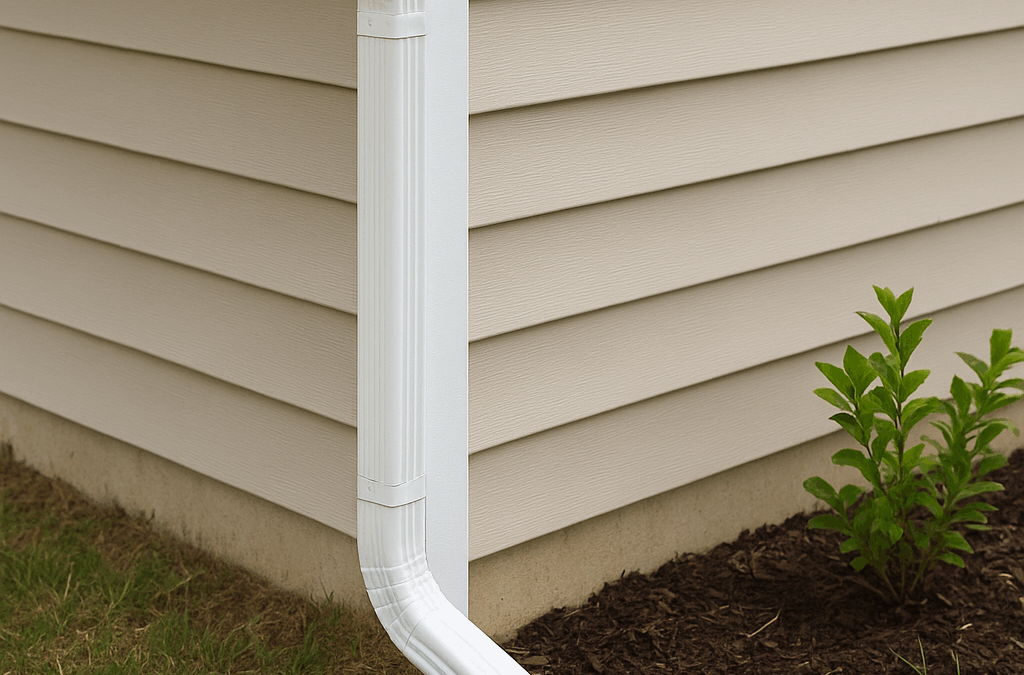
Among the components of a residential gutter system, downspout extensions and ground-level discharge management are the most frequently overlooked and the most consequential for the system’s ability to protect a Cincinnati home’s foundation. Homeowners who invest in clean gutters, secure hangers, and properly sealed joints — but who allow downspouts to terminate at grade level without extensions directing water away from the foundation — have managed roof-level water collection while leaving ground-level water discharge unmanaged. In Cincinnati’s Ohio Valley climate, with its substantial spring rainfall, clay-influenced soils, winter freeze-thaw cycling, and high summer humidity, this ground-level discharge deficiency creates foundation moisture conditions that are directly connected to the basement water intrusion, foundation wall cracking, and structural moisture damage that Cincinnati homeowners encounter. Gutters Etcetera believes that Cincinnati homeowners benefit from understanding downspout extensions, discharge management options, and the site-specific considerations that Cincinnati’s topography and geology create for ground-level drainage management.
The Foundation Protection Purpose of Discharge Management
Every inch of rainfall that falls on a Cincinnati home’s roof surface becomes runoff that the gutter system collects and routes to the downspout outlets at grade. On a typical Cincinnati home with 1,500 to 2,500 square feet of roof surface, a one-inch rainfall event generates between 900 and 1,500 gallons of runoff. Without extensions directing this water away from the foundation, every downspout concentrates a proportional share of this volume at the foundation perimeter in a high-velocity stream that erodes soil, saturates foundation perimeter ground, and drives the moisture conditions that create basement intrusion and foundation movement over time.
Cincinnati’s clay-influenced Ohio Valley soils respond to this concentrated perimeter moisture with the shrink-swell behavior that characterizes expansive clays — expanding under saturation and contracting as they dry, creating the lateral and vertical pressure cycling on foundation walls and footings that contributes to the cracking, movement, and water intrusion that Cincinnati homeowners in clay soil areas encounter with meaningful frequency. Cincinnati’s winter freeze-thaw cycling adds another dimension — water that has saturated foundation perimeter soil from downspout discharge that freezes during winter cold events expands as it freezes, creating additional mechanical pressure on foundation walls and the frost heave forces that affect shallow foundation components.
Managing where downspout discharge goes at grade — moving it away from the foundation perimeter through extensions, underground systems, or other discharge management — directly and meaningfully reduces the foundation moisture cycling that these soil and climate conditions translate into structural stress.
Extension Options for Cincinnati Residential Applications
Rigid Extensions: Rigid aluminum or vinyl extensions are the standard and most durable above-grade discharge management solution for Cincinnati residential applications. Attached to the downspout elbow at grade, rigid extensions carry discharge horizontally away from the foundation before releasing at ground level. Their durability in Cincinnati’s freeze-thaw cycling environment is a meaningful advantage over flexible plastic alternatives that can become brittle and crack under winter temperature extremes. Length should be sufficient to discharge water at a point where it drains away from rather than back toward the foundation — a minimum of four to six feet as a general guideline, adjusted for site-specific topographic conditions.
Flexible Corrugated Extensions: Corrugated plastic flexible extensions are adaptable to complex site conditions and are widely used in Cincinnati residential installations. In Cincinnati’s freeze-thaw climate, the increased brittleness of corrugated plastic under winter temperature extremes can cause cracking and joint failures over time — an installation lifetime consideration that rigid extensions avoid. Flexible extensions displaced by lawn maintenance equipment or freeze-thaw ground movement require regular position checks to maintain their intended discharge direction.
Hinged Flip-Up Extensions: Self-deploying hinged extensions that fold flat during dry conditions and open to discharge position during rainfall reduce above-grade obstruction during Cincinnati’s outdoor maintenance seasons while providing functional discharge management during storm events. Their mechanical simplicity — no electrical components or moving parts beyond the hinge — makes them durable in Cincinnati’s variable climate.
Underground Drainage Systems: Buried drainage piping connected to downspout outlets provides the most permanent, visually clean, and maintenance-free discharge management solution available for Cincinnati homes. Underground systems are particularly appropriate for Cincinnati properties where above-grade extension hardware would be inconvenient, aesthetically undesirable, or difficult to route appropriately around established landscape features. In Cincinnati’s freeze-thaw climate, underground systems should be installed at appropriate depth to prevent freeze damage to the pipe and should incorporate outlets — pop-up emitters or daylighting pipes at the property perimeter — that are positioned where outlet freeze damage and blockage risk is minimized.
Rain Barrels: Rain barrel systems connected to downspouts capture initial discharge for irrigation reuse. Their limited capacity relative to Cincinnati’s significant spring storm events makes overflow management — routing barrel overflow away from the foundation when capacity is exceeded — an essential component of any rain barrel installation intended to contribute to foundation moisture protection.
Cincinnati’s Specific Topographic and Soil Considerations
Cincinnati’s topography is defined by the Ohio River valley system — the main Ohio valley floor and the network of tributary creek valleys that cut through the metropolitan area, flanked by hillside terrain that rises significantly above the valley floors. This topographic diversity creates site-specific drainage conditions across the metropolitan area that affect downspout extension requirements significantly.
Valley Floor and Flat Terrain: Residential areas on Cincinnati’s valley floors and relatively flat terrain — portions of the Mill Creek corridor, the Little Miami valley areas, and the flatter suburban developments of Hamilton County and Northern Kentucky — have limited topographic grade to assist surface water movement away from structures. On these flat sites, downspout extensions must carry discharge far enough from the foundation that water does not simply pool adjacent to the home on the flat grade. Underground systems connecting to street drainage or property-edge outlets are often the most effective solution where flat terrain limits the effectiveness of above-grade extensions.
Hillside Properties: Cincinnati’s hillside neighborhoods — Hyde Park’s elevated terrain, Mount Lookout, the eastern hillside communities, and the Kentucky hillside suburbs across the river — have significant topographic grade that both assists discharge management and creates site-specific challenges. On hillside properties, understanding the direction of slope at each downspout location determines whether natural grade assists or opposes discharge management. Downspouts on a home’s uphill face discharge to grade where natural slope carries water away; downspouts on the downhill face may discharge to grade where slope concentrates drainage toward the foundation. Site-specific extension direction and length should account for the actual topographic drainage behavior at each downspout location.
Creek Valley Properties: Cincinnati’s numerous creek corridors — the Little Miami, the Great Miami’s tributaries, Mill Creek and its branches — create valley floor and lower slope residential areas where high water tables and seasonal flooding add drainage management complexity. For properties in these locations, downspout discharge management that minimizes foundation perimeter saturation is particularly important because high water table conditions already create elevated basement moisture risk that concentrated downspout discharge at the foundation compounds.
The Freeze-Thaw Dimension of Cincinnati Discharge Management
Cincinnati’s winters add a dimension to downspout discharge management that is specific to the Ohio Valley climate and more consequential than in milder southern regions. Water discharged at grade from downspouts during winter rain events on partially frozen ground may not infiltrate immediately, instead running across frozen soil surfaces toward the foundation perimeter. Extensions that direct this discharge away from the foundation on unfrozen ground may not achieve the same protective result on frozen ground where water movement patterns differ from unfrozen conditions.
Underground drainage systems, properly installed at adequate depth, largely bypass the frozen ground surface runoff issue by carrying discharge below grade to a remote outlet. For above-grade extension systems, ensuring that discharge points are on slopes that carry water away from the foundation even under frozen surface conditions is an important winter-specific design consideration for Cincinnati installations.
Ice formation at extension outlets — where the flowing water from a downspout discharge meets cold air during winter events — can create ice dams at extension ends that temporarily back up discharge. Extensions with open, ground-level outlet ends (rather than closed or constricted terminations) are less prone to outlet icing than configurations with restricted discharge openings.
Foundation Grading as the Essential Complement
Effective downspout extension management requires properly graded soil adjacent to the foundation to achieve its protective purpose. Foundation grading — soil consistently sloping away from the foundation for the first several feet around the perimeter — ensures that surface water near the foundation moves away rather than accumulating against it.
In Cincinnati’s established neighborhoods, where decades of soil settling, landscape modification, and root activity have altered original foundation grading, flat or inward-sloping conditions adjacent to foundations are common. These grading deficiencies can defeat even well-extended downspouts if discharged water re-enters the foundation perimeter zone along inward-sloping grade. Identifying and correcting foundation grading deficiencies is an important companion to downspout extension management in Cincinnati’s residential environment — particularly in the older housing stock of established neighborhoods where original grading may have changed significantly since construction.
Identifying and Addressing Common Deficiencies
No Extensions: Downspouts terminating without any extension at grade are the most common and most easily corrected discharge management deficiency. This condition may be original to the installation or may result from extensions that were removed, displaced, or damaged and not replaced.
Extensions Pointing Toward the Foundation: Extensions that have been repositioned — intentionally or by accidental displacement — to discharge toward the foundation, against the home’s wall, or into a depression near the foundation actively worsen foundation moisture conditions compared to no extension at all. Position checks after lawn maintenance and storm events maintain correct orientation.
Blocked Underground Outlets: Underground system outlets — pop-up emitters, outlet pipes — blocked by leaf accumulation, sediment, or root growth prevent system drainage, backing water up through the downspout and into the gutter above during heavy rainfall. Annual outlet inspection and clearing maintains system function through Cincinnati’s seasonal debris cycles.
Inadequate Extension Length on Flat Sites: Extensions that technically extend from the downspout but terminate too close to the foundation on flat Cincinnati lots may not create meaningful discharge-to-foundation separation in the slow-drainage clay soil conditions of many Cincinnati residential sites. Evaluating whether discharge at the extension outlet actually moves away from the foundation under the specific drainage conditions of the site — rather than simply pooling adjacent to the home — determines whether extension length is adequate.
Practical Maintenance Recommendations
Pre-Spring Season Check: A systematic inspection of all extension positions, outlet conditions, and underground system emitter function before Cincinnati’s active spring rainfall season confirms that the complete discharge management system is ready for the year’s most demanding precipitation period.
Post-Maintenance Position Verification: After lawn mowing, trimming, and seasonal landscape work, a quick check of extension positions confirms that maintenance activities have not displaced extensions from proper orientation.
Autumn Outlet Clearance: Cincinnati’s significant autumn leaf fall — from the metropolitan area’s diverse hardwood canopy — can block pop-up emitters and underground outlet pipes. Clearing these outlets before the onset of winter precipitation maintains system function through the cold season.
Winter Observation: During winter rain events on frozen or partially frozen ground, observing where water actually flows from extension outlets — rather than assuming it behaves as it would on unfrozen ground — identifies any winter-specific discharge management deficiencies that require attention.
Conclusion
Downspout extensions and ground-level water discharge management are the essential final component of a complete residential gutter system for Cincinnati, Ohio homes — the element that determines whether roof runoff collected efficiently at the gutter level is safely moved away from the foundation or deposited at the perimeter location most likely to drive the moisture cycling that Cincinnati’s clay soils, winter freeze-thaw conditions, and substantial spring rainfall translate into basement intrusion and foundation stress. Gutters Etcetera recognizes that Cincinnati homeowners who understand the critical role of ground-level discharge management — and who maintain proper extension length, correct discharge orientation, functional underground systems where installed, and appropriate foundation grading as the essential complement — are providing their foundations and homes with the complete, roof-to-discharge-point water management that Cincinnati’s four-season Ohio Valley climate demands.