Cincinnati homeowners face distinctive seasonal challenges that many residents underestimate until problems develop. Gutters Etcetera serves the Greater Cincinnati area with educational resources that help property owners understand why maintaining functional drainage infrastructure throughout Ohio’s variable winters protects homes from expensive damage.
Cincinnati’s Unique Winter Climate
The Queen City’s position along the Ohio River creates weather patterns that differ from surrounding regions. This geographical location produces temperature variability, mixed precipitation types, and frequent weather system transitions. Understanding these patterns helps homeowners anticipate maintenance needs and timing.
Winter temperatures in Cincinnati fluctuate significantly both within individual days and across weekly periods. Morning lows in the teens might be followed by afternoon highs approaching fifty degrees. Arctic air masses alternate with Gulf moisture, creating conditions where rain, snow, sleet, and freezing rain all occur within single weather systems.
This variability means Cincinnati homeowners cannot prepare for stable cold winters like those in northern Michigan or mild winters typical of Tennessee. Instead, they face constantly changing conditions that test building systems through repeated freeze-thaw cycling—arguably more damaging than sustained cold temperatures.
Precipitation totals remain substantial throughout winter months. December through February typically deliver combined totals exceeding ten inches. Unlike fully northern climates where this moisture falls as snow and remains frozen until spring, Cincinnati receives mixed precipitation requiring continuous management rather than deferred seasonal handling.
Fundamental Drainage System Functions
Residential water management systems operate on straightforward principles. Channels mounted along roof edges intercept precipitation falling on roof surfaces before it cascades off edges. This collected water flows through channels to downspout collection points, then through vertical downspout sections to ground-level discharge locations positioned away from foundations.
This mechanism protects multiple home components simultaneously. Foundations remain dry because water discharges six or more feet away rather than saturating adjacent soil. Exterior walls avoid constant moisture exposure because water doesn’t sheet down siding. Landscaping, walkways, and driveways remain intact because erosive water flow gets directed to appropriate locations.
When drainage systems become obstructed, water seeks alternative paths following gravity and path-of-least-resistance principles. These alternative paths typically damage materials never intended for constant water exposure—fascia boards, soffit panels, exterior wall assemblies, and foundation perimeters.
Blockage Causes and Consequences
Multiple factors contribute to drainage system obstructions. Fallen leaves represent the most obvious source, particularly during autumn when deciduous trees shed foliage rapidly. However, leaves aren’t the only concern.
Asphalt shingles gradually release mineral granules that wash into channels during rain events. Roof-mounted equipment including satellite dishes and HVAC condensers shed debris. Birds drop nesting materials and fecal matter. Wind deposits seed pods, twigs, and various organic debris. Over time, these materials accumulate into significant blockages even in areas without heavy tree coverage.
Once blockages form, consequences follow predictable patterns. Water backs up behind obstructions, overflowing channel edges or finding weak points at seams and end caps. This overflow water cascades down fascia boards and siding rather than flowing through intended drainage paths.
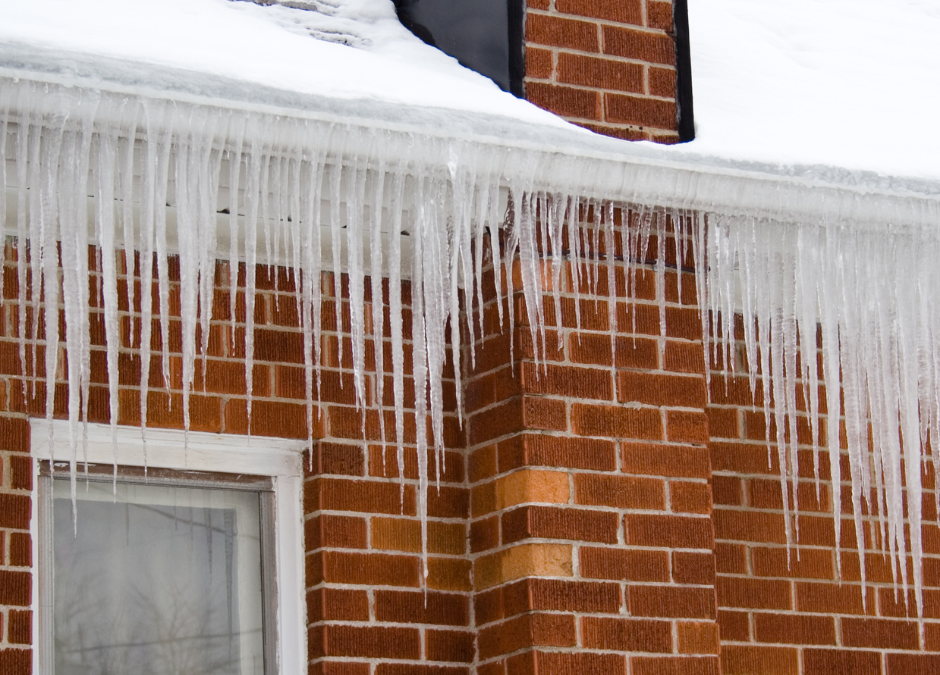
During freezing temperatures, standing water within obstructed channels transitions to ice. This ice formation creates multiple problems: physical expansion forces that damage channel materials, weight loading that stresses mounting hardware, and persistent blockages that remain even when temperatures moderate.
Ice Formation Mechanics and Impacts
Water’s transition from liquid to solid involves approximately nine percent volume expansion. This seemingly modest increase generates tremendous force—sufficient to crack concrete, split wood, and deform metals. In drainage applications, this expansion operates against channel walls, mounting brackets, fascia boards, and any debris creating constriction points.
Cincinnati’s temperature fluctuations mean freeze-thaw cycles repeat frequently throughout winter. Water melts during warmer periods, flows to low spots or blockage points, then refreezes when temperatures drop. Each cycle stresses materials through expansion force and accumulating weight. Aluminum develops fatigue cracks at bends and seams. Steel mounting brackets deform. Wood fascia boards split. Plastic components become brittle and crack.
The cumulative damage from repeated cycling often exceeds what sustained freezing would cause. In stable cold climates, water freezes once and remains frozen until spring. In variable climates like Cincinnati’s, materials endure dozens of freeze-thaw events, each contributing incremental damage that compounds over the season.
Foundation Risks From Inadequate Drainage
Home foundations represent the literal base of structural integrity. Any compromise to foundation stability affects everything built upon it. Cincinnati-area soils create particular vulnerabilities when combined with inadequate drainage.
Clay particles dominate many local soil compositions. Clay exhibits pronounced shrink-swell characteristics—expanding significantly when wet and contracting when dry. This behavior occurs regardless of temperature, driven purely by moisture content changes.
Winter adds freezing temperatures to existing clay expansion issues. Water-saturated clay soil adjacent to foundations expands from moisture absorption. When this already-expanded soil freezes, the water-to-ice phase change adds additional expansion. These combined forces create substantial lateral pressure against foundation walls.
Poured concrete foundations develop hairline cracks under sustained pressure. These cracks propagate with repeated freeze-thaw cycling, widening to allow water infiltration into basements. Concrete block foundations may shift as individual courses move independently when mortar joints fail. Brick foundation veneers can separate from underlying structural walls.
Foundation repair costs rank among the highest in residential maintenance. Major foundation work requiring excavation, waterproofing, and structural reinforcement can reach twenty thousand dollars or more. Preventing foundation damage through proper drainage maintenance represents extraordinary return on minimal maintenance investment.
Roof Assembly Vulnerabilities
Ice dam formation represents one of winter’s most destructive drainage-related phenomena. These ice accumulations develop through a sequence of conditions that obstructed channels enable and encourage.
The process begins with heat loss from living spaces into attic areas. Despite insulation, some thermal transfer occurs, warming attic air and underlying roof surfaces. This warmth melts accumulated snow even when outdoor temperatures remain below freezing. Meltwater flows downslope following gravity.
When meltwater reaches roof overhangs, it encounters surfaces no longer warmed by attic heat. Here the water refreezes. Clear, functional drainage channels would carry most meltwater away before significant refreezing occurs. Obstructed channels create standing water that refreezes into progressively larger ice formations.
Growing ice dams create barriers that prevent subsequent meltwater drainage. Water pools behind these barriers, eventually covering areas where shingles were never designed to be waterproof. Standard asphalt shingles shed water flowing down their surfaces but cannot prevent infiltration from standing water or upward water migration.
Once water penetrates past shingles, it contacts underlayment felt paper, then plywood or OSB roof decking. These materials absorb moisture, leading to swelling, warping, and fungal decay. Water continues downward into insulation, reducing thermal effectiveness and potentially dripping onto ceiling materials.
Interior damage manifestation often lags weeks behind initial infiltration. Ceiling stains appear first, followed by paint peeling, drywall sagging, and eventual water dripping. By the time visible symptoms appear, hidden structural damage may be extensive, requiring costly repairs to roof decking, framing, insulation, and interior finishes.
Wood Component Deterioration Patterns
Residential construction uses dimensional lumber extensively despite increasing use of engineered materials. Exterior applications including fascia boards, soffit backing, window and door trim, and decorative elements rely heavily on wood.
Wood tolerates occasional wetting from rain that subsequently dries without permanent damage. However, constant moisture exposure exceeds wood’s tolerance, promoting conditions favorable for fungal colonization and decay.
Drainage system overflow subjects fascia boards to continuous water contact. These vertical boards running along roof edges serve multiple purposes: aesthetic finished appearance, structural support for drainage system mounting, and weather protection for exposed rafter tails. When constantly wet, fascia wood becomes ideal substrate for decay fungi.
Wood rot fungi require specific conditions: wood moisture content exceeding twenty percent, temperatures between roughly forty and ninety degrees Fahrenheit, and available oxygen. Wet fascia boards during typical Cincinnati winter temperatures provide perfect colonization conditions. Once established, decay progresses rapidly, consuming cellulose and lignin that provide wood’s structural strength.
Rotted fascia cannot support drainage system mounting hardware. Screws and nails pull out from deteriorated wood, allowing systems to sag or detach completely. Beyond mechanical failure, visible rot signals probable problems in adjacent components. Roof sheathing, rafter tails, and soffit backing boards may also be experiencing moisture damage requiring carpentry repairs far exceeding simple fascia replacement.
Soffit panels spanning space between exterior walls and fascia also suffer from drainage overflow. These horizontal panels provide attic ventilation while presenting finished appearance. Wood soffits exposed to constant moisture warp, crack, and decay. Even aluminum or vinyl soffit panels deteriorate when underlying wood support structure rots, leading to sagging and separation.
Ohio River Valley Weather Dynamics
Cincinnati’s location within the Ohio River Valley creates distinctive weather patterns. The river itself moderates temperature extremes somewhat while contributing moisture to precipitation events. Valley topography channels weather systems, occasionally intensifying precipitation rates and wind speeds.
Weather transitions occur rapidly in valley settings. Warm fronts advancing from the south collide with cold fronts descending from Canada, creating sharp temperature gradients and active weather. These transition zones produce mixed precipitation—rain changing to sleet, then snow, then back to rain as temperature layers shift overhead.
These rapid transitions catch homeowners unprepared. Rain fills drainage channels with water during above-freezing periods. When temperatures plunge as cold fronts pass, this standing water freezes solid within hours. The resulting ice blockages persist even when temperatures later moderate, creating ongoing drainage problems until physical removal occurs or sustained warmth melts accumulated ice.
Local tree populations add complexity to drainage maintenance. Cincinnati’s urban forest includes diverse species: oaks, maples, sycamores, sweetgums, and others. These trees shed leaves on different schedules, with some varieties retaining dead foliage into December or dropping leaves during winter storms.
The extended leaf-fall period means autumn cleaning may not suffice. Channels cleaned thoroughly in October often fill again by December as late-shedding species complete their cycles and winter storms deposit additional debris. Understanding this pattern helps property owners schedule maintenance timing and frequency appropriately.
Pest Exploitation of Obstructed Systems
Accumulated organic material within blocked drainage channels creates microhabitats attractive to various animal species. Damp leaves, twigs, and seed material provide insulation, weather protection, and potential nesting material or food sources.
Eastern gray squirrels—abundant throughout Cincinnati—commonly exploit debris-filled channels. These resourceful rodents build winter nests (dreys) within accumulated debris or use blocked channels as protected pathways to access roof and attic spaces. Once squirrels gain attic entry, they cause significant damage through gnawing, insulation displacement, and waste accumulation.
Other rodents including Norway rats, roof rats, and house mice also utilize obstructed drainage systems. These animals compress their bodies remarkably, fitting through openings as small as one-half inch. Accumulated debris provides staging areas for entry attempts into wall cavities and interior spaces. Beyond property damage, rodents carry diseases including leptospirosis, hantavirus, and salmonellosis transmissible to humans.
Bird species frequently nest in protected locations where channels meet walls or in upper downspout openings. European starlings, house sparrows, chimney swifts, and rock pigeons build substantial nests that completely obstruct water flow. These nests often remain through winter, creating persistent blockages that survive even after other debris is removed.
Insect populations flourish in damp, organic-rich environments within blocked channels. Carpenter ants excavate galleries in moisture-damaged wood components. Subterranean termites may establish colonies in persistently damp fascia boards. Mosquitoes breed in standing water during warmer periods. These pest issues create structural damage risks and disease transmission concerns extending far beyond simple nuisance.
Effective Maintenance Practices
Property owners can implement practical maintenance routines to preserve drainage functionality throughout winter. Regular inspection forms the cornerstone of effective maintenance. Brief property perimeter walks after significant weather events reveal developing problems before they cause serious damage.
Observable indicators of drainage dysfunction include ice formations hanging from channel front edges, icicle patterns suggesting overflow points, water staining on siding below channel runs, and sagging or separated channel sections pulling away from fascia mounting. Ground-level indicators include erosion patterns near foundations, standing water around building perimeters, and ice sheets extending from downspout discharge points.
Appropriate maintenance timing maximizes effectiveness while minimizing repeated effort. For Cincinnati properties, late November through early December typically represents optimal timing. This window follows peak leaf-fall for most species while preceding sustained freezing temperatures. Properties with significant oak populations may require follow-up attention in mid-to-late December.
Downspout functionality requires verification separate from horizontal channel inspection. Blockages within vertical downspout sections prevent drainage even when horizontal channels are perfectly clear. Testing involves introducing water at upper channel entry points while observing discharge at ground level. Reduced or absent discharge indicates downspout obstructions requiring physical removal through flushing or mechanical means.
Ground-level drainage extensions warrant attention during inspection. These attachments extend discharge points away from foundations, preventing soil saturation. Verify extensions remain properly connected and positioned to discharge water minimum six feet from foundation walls. Extensions that have disconnected, shifted toward foundations, or become clogged defeat the entire system’s protective purpose.
Safety Considerations for Cold-Weather Work
Winter exterior maintenance work introduces hazards absent during warmer seasons. Ladder stability decreases on frozen, saturated, or snow-covered ground. Metal ladder components become extremely slippery when wet or icy. Shortened daylight hours mean work frequently occurs in marginal lighting that obscures visual hazard identification.
Cold temperatures impair human physical and cognitive performance. Manual dexterity decreases as extremity temperatures drop below optimal ranges, making it difficult to grip tools, maintain balance, and perform fine motor tasks. Cognitive processing and reaction times slow in cold conditions, reducing ability to recognize and respond to developing hazards. Bulky winter clothing restricts movement and can catch on ladder rungs, roof projections, or equipment.
Essential safety equipment for winter exterior work includes insulated work gloves providing both thermal protection and grip enhancement on cold, wet surfaces. Footwear should feature aggressive tread patterns and flexible soles maintaining grip on cold metal ladder rungs. Ladder stabilizers improve stability while preventing channel damage from concentrated rung pressure. Hard hats protect against impacts from falling ice or debris.
Weather conditions must dictate work scheduling decisions. Wind speeds exceeding ten to fifteen miles per hour create dangerous conditions for ladder work regardless of temperature. Wet conditions from rain, snow, or ice dramatically increase slip and fall risks. Temperatures below twenty degrees Fahrenheit impair physical performance and increase cold injury risks. When conditions appear marginal, postponing work until safer weather represents prudent judgment rather than excessive caution.
Professional service providers offer advantages beyond simple convenience for winter maintenance. Commercial ladder systems include enhanced stabilization features and safety components. Technicians receive comprehensive training in cold-weather work procedures, hazard recognition, and emergency response. Liability insurance and workers’ compensation coverage protect property owners from financial exposure should accidents occur during maintenance activities.
Economic Analysis of Preventative Maintenance
Well-maintained drainage systems deliver decades of reliable service. Quality aluminum systems commonly function thirty years or more. Copper systems may exceed fifty years with proper care. These service lives assume regular maintenance prevents damage from debris accumulation, ice loading, overflow-related deterioration, and corrosion.
Neglected systems fail far sooner than maintained counterparts. Excess weight from ice and saturated debris stresses mounting hardware, fascia boards, and channel materials beyond design specifications. Standing water and organic acids accelerate corrosion of metal components. Overflow water damages supporting structures including fascia, soffit, and roof edge components, creating conditions requiring complete system replacement plus extensive carpentry repairs.
Replacement costs for typical Cincinnati homes range from two thousand to six thousand dollars depending on property size, architectural complexity, system materials, and access difficulty. Premium materials including copper or heavy-gauge aluminum increase costs further. These expenses far exceed annual maintenance costs whether performed personally or through professional services.
Beyond direct system replacement costs, functional drainage protects numerous home components whose repair or replacement expenses dwarf drainage system values. Foundation repairs commonly exceed ten thousand dollars, with major work requiring excavation and structural reinforcement reaching twenty thousand or more. Roof repairs addressing ice dam damage range from hundreds to thousands depending on extent. Complete roof replacement costs ten thousand to thirty thousand or more. Siding replacement runs five thousand to twenty-five thousand. Interior remediation for water damage adds thousands more. Preventing these expenses through relatively modest drainage maintenance investment represents extraordinary financial return.
Long-Term Property Value Preservation
Real estate market dynamics consistently favor well-maintained properties over those showing deferred maintenance. Visible maintenance issues including damaged or missing drainage components, water-stained siding, rotted trim, or foundation cracks negatively impact buyer perceptions and professional appraisals.
Properties displaying obvious maintenance neglect sell for less than comparable well-maintained homes. Market time typically extends as fewer buyers express interest and those who do submit lower offers. In competitive markets, poorly maintained properties may fail to attract any offers at acceptable prices.
Foundation issues create particular concern for potential buyers and their mortgage lenders. Evidence of foundation problems including cracks, shifting, previous repairs, or ongoing moisture infiltration raises red flags that may prevent conventional financing approval. Even after repairs, properties with documented foundation histories may appraise lower than comparable properties without such issues, affecting both sale prices and loan approval.
Interior water damage creates serious marketability obstacles. Ceiling stains, wall discoloration, mold growth, musty odors, or visible previous repairs signal current or historical moisture intrusion. Many buyers refuse to consider properties with water damage history regardless of remediation performed. Those willing to consider such properties typically demand substantial price reductions and may require extensive documentation of remediation work, mold testing results, and contractor warranties.
Maintaining functional drainage systems throughout ownership protects against these value-impacting issues. The modest investment in regular seasonal maintenance preserves property value while delivering immediate benefits through damage prevention and component longevity extension.
Conclusion
Gutters Etcetera encourages Cincinnati-area homeowners to recognize winter drainage maintenance as essential home protection rather than optional convenience. The Queen City’s position along the Ohio River creates weather patterns that challenge residential water management infrastructure through temperature variability, mixed precipitation types, and frequent freeze-thaw cycling. Understanding these distinctive local conditions enables property owners to make informed decisions about maintenance timing, methods, and whether to pursue professional assistance. Through consistent inspection routines, appropriate seasonal maintenance scheduling, and attention to safety protocols, Cincinnati residents can protect their properties from preventable winter water damage while preserving long-term value and avoiding expensive repairs to foundations, roofs, exterior components, and interior spaces. Whether homeowners choose personal maintenance approaches or professional service engagement, prioritizing drainage system care during Ohio’s variable winters represents sound investment in comprehensive property protection.