
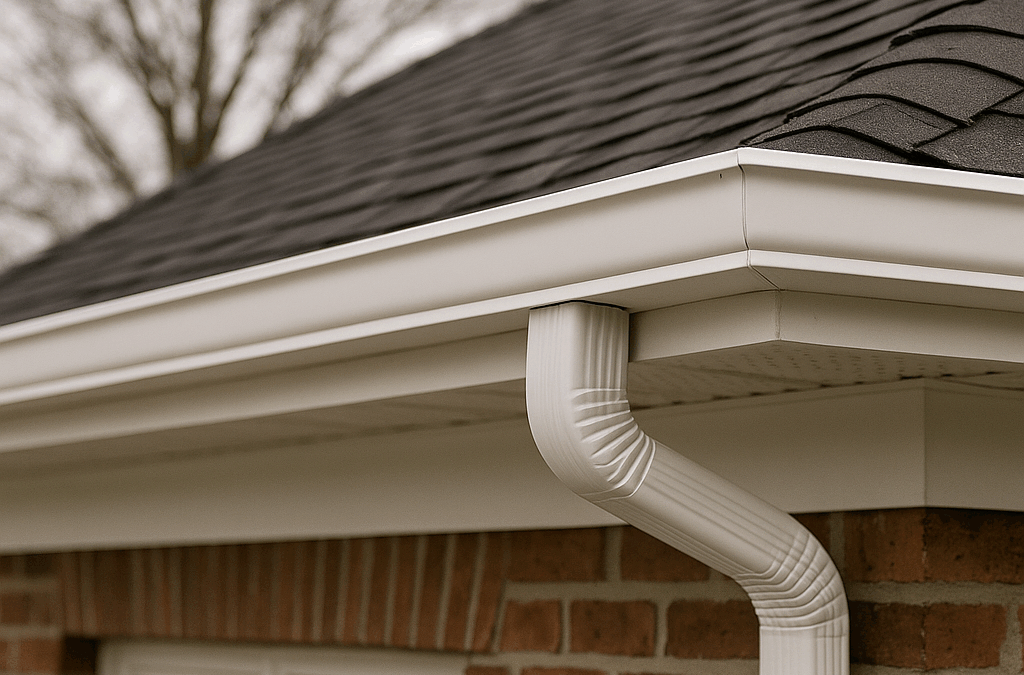
When rain falls across a Cincinnati or Dayton home, the downspouts may not produce matching streams. One can run steadily while another releases only a few drops. The quiet outlet might be restricted, but it may also serve a smaller roof area or receive less wind-driven rain.
Understanding the difference requires following water through several connected stages rather than judging the downspout opening by itself.
A Roof Divides Rain Into Separate Routes
Every slope sends runoff toward a particular eave. Valleys combine water from adjoining slopes, while dormers, porches, garages, and additions can create smaller roof sections. Gutters collect these separate flows and direct them toward selected outlets.
This means two downspouts on the same wall may not carry the same amount of water. One might receive runoff from a large upper roof and a valley. The other might serve only a short lower section.
Before treating unequal flow as a problem, identify which roof surfaces appear to feed each gutter run.
Gutter Slope Assigns Water to an Outlet
The gutter channel is not perfectly level. A subtle pitch guides water toward a downspout.
A long run may slope entirely in one direction. Another may use a high point to divide water between outlets at opposite ends. The dividing point can leave one downspout responsible for more gutter length than the other.
Roof runoff does not necessarily enter the gutter evenly along that length. A valley, intersecting roof, or upper-level downspout can add a concentrated amount near one outlet. That pipe may flow much sooner and faster.
Wind and Storm Direction Affect the Comparison
Ohio Valley rain can arrive with changing wind. A roof slope facing the rain may collect more direct water than one on the sheltered side. Nearby buildings, tree cover, and differences in roof height can modify that exposure.
The active downspout may therefore change from one storm to another. A comparison made during calm, steady rain can look different from one made during a gusty front.
Light rain creates another limitation. A small roof section may not generate enough runoff to produce a visible stream, even though the water is following the expected route.
Debris Can Redirect Part of the Flow
Leaves, fine tree material, twigs, and roof grit do not need to seal an outlet completely to affect drainage. A compact mat can form a shallow barrier inside the gutter. Water may move around it and head toward a second downspout.
Material at an outlet can reduce the opening. Debris in an elbow can slow the stream below. In both cases, the gutter above may still be receiving runoff, so the behavior at the roofline matters as much as the visible discharge.
Gutter and downspout cleaning addresses common debris within the open pathway. It does not alter roof geometry or make separate outlets carry equal volumes.
Four Patterns Provide Different Information
One Downspout Starts First, Then Both Flow
The first outlet may serve a larger area or sit closer to concentrated runoff. A smaller drainage zone can take longer to create a visible stream.
One Downspout Flows Only During Heavy Rain
This can reflect limited roof area. It can also indicate temporary retention in the gutter or a partial restriction. Look for overflow or water remaining in the channel after the storm.
One Downspout Is Dry While Water Spills Above It
The combination is more notable than a dry pipe alone. Debris near the opening is one possible cause, while gutter pitch, alignment, and rapid valley runoff are others.
One Downspout Drips Long After the Other Stops
Water can cling inside elbows and corrugated extensions or remain in a shallow gutter area. Slow final drips do not show how much runoff the pipe carried earlier.
Include the Ground-Level Route
Some downspouts discharge directly onto the surface. Others use extensions or connect to a pipe at ground level. A pipe may be carrying water even when the final release point cannot be seen.
Water surfacing around a buried connection may involve the downstream route rather than the gutter outlet. Likewise, a puddle under one downspout reflects soil, grading, and surface conditions in addition to the amount of roof runoff.
Keeping the upper and lower portions separate prevents one symptom from being used to explain the entire system.
Build a Record From Safe Observations
Watch from stable ground or through a window. Note rainfall intensity, wind direction, the order in which outlets begin flowing, and any overflow location. Compare the same downspouts during a later storm.
Do not climb during rain, stand on frosted or leaf-covered surfaces, or insert an object into an unseen pipe. The gutter is not intended to support climbing equipment. A short phone video can capture timing without requiring close access.
Look for Consistency, Not Identical Streams
Uneven downspout flow can be a normal result of unequal roof areas, gutter pitch, valley placement, and storm direction. Partial debris can create a similar appearance or make an existing difference more noticeable.
For Cincinnati and Dayton homeowners, the clearest clue is consistency across several rains. A quiet downspout becomes more significant when its connected gutter repeatedly fills or overflows during sustained rainfall. Without those accompanying signs, different stream sizes may simply reflect how the roof divides water.