
Fall mornings across southwest Ohio often begin with wet grass, damp vehicles, and beads of moisture on exposed metal. Gutters can collect the same condensation. A separate moisture pattern may appear only during rain, when runoff reaches a joint, crosses the gutter edge, or moves behind the channel.
Since both conditions can leave a gutter wet, homeowners need more than a single glance to tell them apart. Weather, timing, distribution, and repetition provide the clearest clues.
Why a Dry Night Can Produce a Wet Gutter
Humidity describes water vapor in the air. When a metal surface cools to the dew point, some vapor condenses into visible liquid. No rainfall is required.
Gutters can cool during clear, calm nights as outdoor surfaces release heat. If the surrounding air contains enough moisture, droplets begin forming. Cincinnati and Dayton can experience damp fall mornings even after a rain-free evening, particularly around river valleys, low areas, and shaded neighborhoods.
Local setting influences the timing, but condensation is a normal atmospheric process. It does not demonstrate that the gutter channel leaked.
What Morning Condensation May Look Like
Dew often creates fine beads across a large surface. The front and bottom of a gutter may be damp along with part of the downspout. Similar moisture on cars, fences, roof surfaces, and vegetation supports the condensation explanation.
Drying patterns can make the distribution less obvious. Sunlit metal warms sooner, while a shaded run may retain droplets well into the morning. One elevation can therefore look wet after another side of the same home has dried.
Frost adds another variation later in the season. Frozen condensation may become liquid as sunlight warms the surface. That small amount of meltwater should not automatically be interpreted as rain leakage.
How Rainwater Leakage Tends to Differ
Leakage usually depends on water moving through the system. A drip may recur beneath a corner, end cap, outlet, or downspout connection. It may begin only during rainfall and stop after the channel finishes draining.
A narrow wet trail from one fitting differs from uniform beading. Water showing behind the gutter, on fascia, or near the soffit also suggests a route at the roof edge rather than condensation spread over exposed metal.
Discoloration below the area can show that moisture has traveled there before, but the stain may outlast the condition that created it. A current observation is needed to connect the mark with active water.
Why Overflow Can Be Mistaken for a Hole
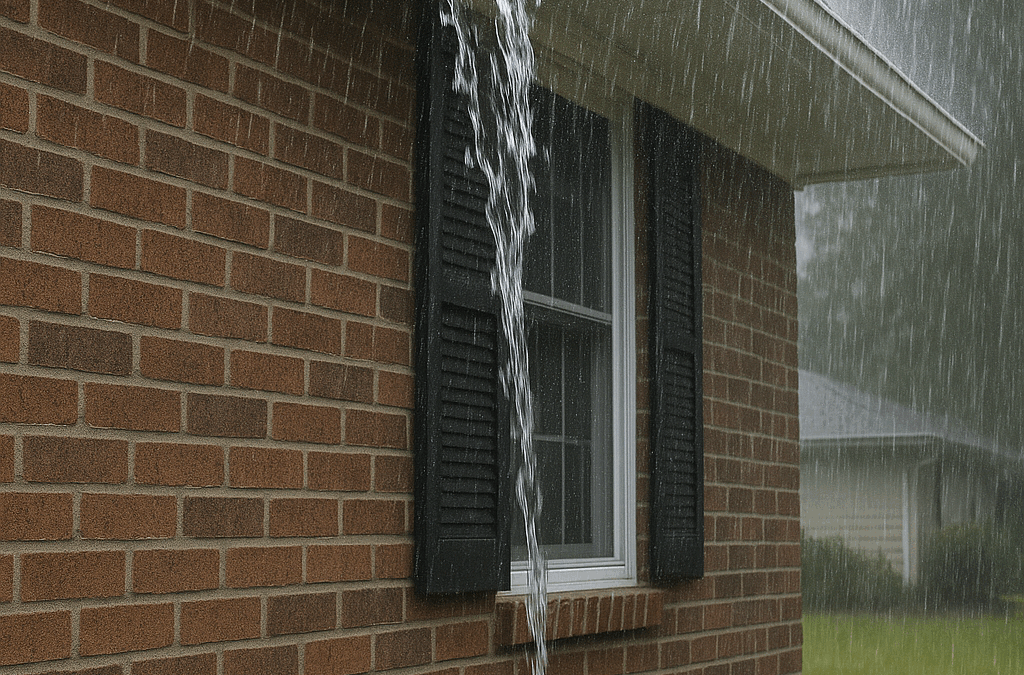
Water that spills over the front can wrap around the lip and release from the gutter’s underside. Viewed from below, the drip may seem to pass directly through the metal. A leaf mat, fine sediment, a downspout restriction, or concentrated roof runoff can influence where this happens.
Southwest Ohio weather can shift from light rain to a strong shower. If the drip appears only as rainfall intensifies, the water level and entry rate are relevant. Wind can add another route by driving rain against the gutter face or roof edge.
Gutter and downspout cleaning addresses debris within the drainage pathway. It may be related when visible buildup accompanies overflow, but it does not affect whether dew forms on a cold exterior surface.
Several Moisture Sources Can Overlap
Condensation does not rule out a leak, and a leaking joint does not stop dew from forming elsewhere. A cool gutter may begin the morning wet and then receive rain before it dries. Under those conditions, a new drip can blend into the existing film.
Observations across different conditions are more reliable. Compare the location after a clear night, during a dry afternoon, in gentle rain, and during a heavier shower. Note whether the moisture is widespread or consistently begins at one point.
Document the Pattern From the Ground
Take photographs that show both the suspected spot and adjacent sections. An early-morning image can record dew distribution, while a later image shows the order in which surfaces dry. Check whether other outdoor objects are wet under the same sky exposure.
During rain, watch from a sheltered location. Identify whether water crosses the front edge, appears behind the gutter, or emerges at a connection. If visible, compare downspout discharge with the timing of the drip.
Avoid climbing in wet or frosty conditions. Gutters should not support ladders, and fallen leaves can make the ground unstable. Binoculars or a camera zoom can provide a closer view without roof access.
The Pattern Matters More Than One Wet Spot
For Cincinnati-to-Dayton homeowners, broad droplets after a cool, clear night are more consistent with condensation. A concentrated drip that repeats while rainwater flows has a different explanation. Overflow, melting frost, wind-driven rain, and roof-edge water can create additional patterns.
Tracking when the moisture begins and how it dries helps distinguish these conditions. That context prevents an ordinary dew event from being labeled a leak and gives rain-related moisture a clearer timeline for evaluation.