
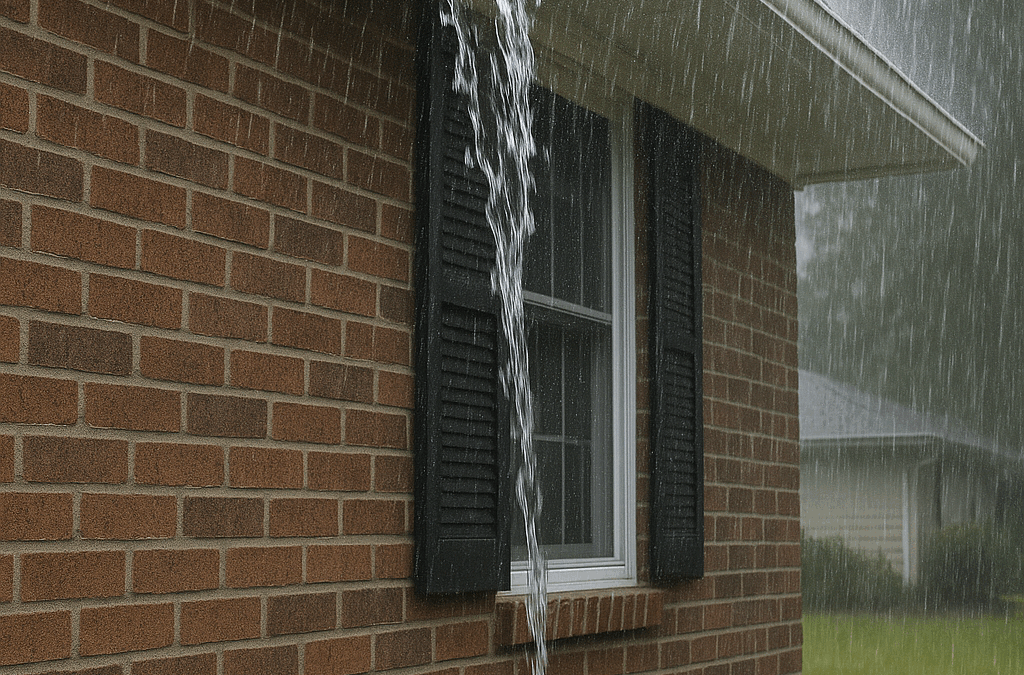
Fall rain can leave a round pool below one downspout while another outlet on the same house has no standing water. The difference may begin at the gutter, but it can also arise after runoff reaches the ground. Soil moisture, slope, paving, landscaping, and storm duration all influence the result.
For homeowners between Cincinnati and Dayton, following the water in sequence is more reliable than assuming every puddle has the same cause.
Downspouts Deliver Concentrated Water
Each downspout receives runoff collected from a section of roof. That flow reaches a small area at the outlet, so the ground may receive water faster than it would from rainfall alone.
A puddle can therefore appear while the gutter and downspout are still moving water. If discharge is strong and the roofline shows no overflow, the visible pool may be developing after water exits the system. If water spills above while little emerges below, the observed sequence points elsewhere.
Neither observation is a complete diagnosis. It simply separates two stages of the route.
Earlier Rain Changes Later Rain
Ground conditions at the start of a storm matter. Relatively dry soil may absorb the first rainfall, but its capacity can decrease as the storm continues. A second rainy day can produce more surface water than the same amount falling after a dry week.
Ohio Valley fall weather can include extended light rain as well as short, intense events. A downspout puddle that begins late in a long storm may relate partly to saturation. A pool that forms immediately in the same outline may reflect a local depression or barrier.
Compacted soil, roots, construction backfill, and landscaping materials add variation. Even neighboring properties can drain differently.
The Immediate Grade Controls Direction
Water does not respond to how level a yard looks from a distance. It follows the small slopes directly beneath and beyond the outlet. Settled soil can create a bowl, while edging or pavement can hold water in place.
On sloped ground, runoff may create a narrow track instead of a broad puddle. Look for sediment, moved mulch, flattened grass, or a damp trail. These marks may reveal direction after repeated storms, but they do not determine how the gutter behaved above.
Hard surfaces offer another pattern. Water on concrete cannot soak in at the outlet, so it spreads toward joints, low spots, or edges. A stain may remain after the water is gone and should not be confused with active pooling.
Leaves Can Gather at the Bottom
Autumn material does not remain only on the roof. Wind and runoff can collect leaves around a downspout opening. A wet mat may deflect the stream, cover a ground drain, or slow surface movement. The resulting puddle can appear beside the outlet rather than directly under it.
Debris may also occur inside the gutter-and-downspout route. Gutter and downspout cleaning concerns that internal material. It does not alter soil absorption, landscaping, or surface grade.
Compare the amount leaving the outlet with activity at the roofline. Weak discharge combined with overflow differs from a full stream that reaches a saturated low spot.
A Buried Pipe Adds an Unseen Stage
Some downspouts connect to pipes at ground level. The underground destination, slope, and outlet may not be visible from the house. Water surfacing around the connection can therefore involve a separate section beyond the downspout.
Avoid assuming that an underground pipe is clear or blocked based only on the gutter’s appearance. Do not separate wet fittings during a storm. Mapping or evaluating a buried route is a different task from observing the open portions of the gutter system.
Record the Storm From Ground Level
From a sheltered location, watch the upper gutter and lower outlet during rain. Note whether overflow starts before the puddle, whether the discharge stream changes, and where surface water travels.
Do not use a ladder, stand on saturated slopes, or remain outside during lightning. A zoomed video can preserve the sequence from a stable location.
After the rain, photograph the pool and check it again as conditions dry. Record whether the water disappears within a short period or remains. Repeat the comparison after a lighter or heavier storm. Consistent observations are more informative than adding water to the system as a test.
Understanding a Cincinnati-to-Dayton Downspout Puddle
Standing water near a downspout may reflect concentrated roof runoff, saturated or compacted soil, a shallow low spot, outlet debris, hardscape, or an underground connection. Several influences can be present at once.
The most useful evidence follows the entire visible route: gutter edge, downspout flow, outlet behavior, surface direction, and drying time. For Cincinnati-to-Dayton homeowners, that sequence can clarify which part of the water path is visible and which part remains unknown.