
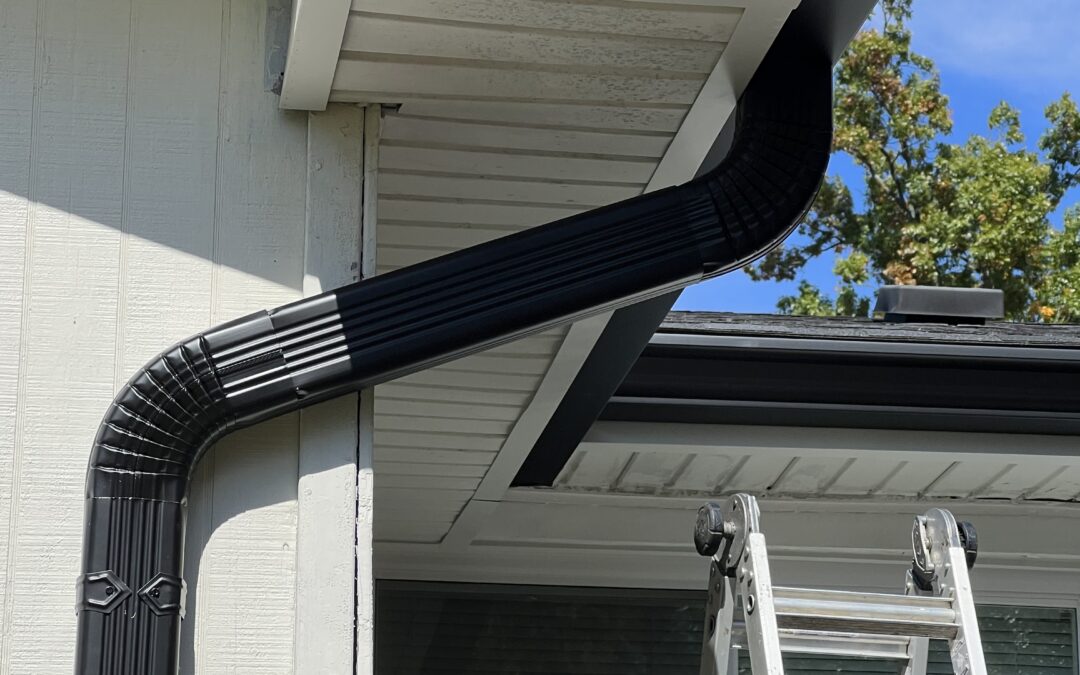
A noisy downspout can be distracting indoors and puzzling outside. Homeowners between Cincinnati and Dayton may hear a steady rush, irregular gurgle, metal rattle, hollow knock, or lingering drip during Ohio Valley rain. These sounds do not all have the same cause.
Some are ordinary results of water moving through a narrow metal path. Others can provide clues about debris, airflow, loose sections, or conditions where the downspout discharges. The pattern becomes more useful when it is considered alongside visible water behavior.
How a Downspout Turns Runoff Into Sound
A gutter gathers water across a wide roof edge and funnels it into a smaller outlet. The downspout carries that concentrated flow vertically, redirects it through elbows, and releases it at ground level.
Water striking metal produces vibration. Straps can transfer that vibration to trim, siding, brick anchors, or framing. A pipe beside a bedroom may therefore seem louder than one near a garage, even if both carry a similar amount of water.
The roof also influences sound. A valley or upper roof can deliver runoff rapidly to one gutter section. Complex rooflines may create uneven surges rather than a perfectly steady flow.
A Continuous Rush May Be Typical
Smooth rushing that follows the intensity of the rain is often a normal drainage sound. It becomes louder as rainfall increases and fades when less water reaches the gutter.
Every downspout route has a different acoustic pattern. Pipe dimensions, number of elbows, mounting surface, and discharge type all matter. Comparing the same downspout across several storms is generally more informative than comparing it with a neighbor’s system.
If a familiar steady sound changes to pulsing, gurgling, or repeated impact, the new behavior may offer a reason to observe the system more closely.
Gurgling Can Indicate Uneven Water and Air Movement
Air needs room to move through a downspout as water flows. A partial restriction may cause both to pass through the same narrow space in separate pulses. This often creates a gurgling or bubbling noise.
The restriction might involve leaves over the upper outlet, needles and sediment inside an elbow, or material farther down the pipe. Water can still emerge at the bottom, but it may arrive in bursts.
Burbling near ground level can have a different source. An outlet or connected extension surrounded by standing water may release trapped air as new runoff enters.
Hard Debris Creates Taps and Rattles
Acorns, buckeyes, seed pods, small twigs, and roof granules can all enter an open gutter system. Their contact with metal produces sharper sounds than leaves or water.
A piece that travels through the entire pipe may create one quick series of taps. Repeated rattling at a bend may indicate that an object is moving back and forth without clearing the elbow.
Southwest Ohio’s fall debris arrives in stages, so the sound may change as different trees release seeds, nuts, and leaves. Wind can add twigs before the main leaf drop begins.
Loose Components May Rattle in Wind or Rain
Downspouts are held near the wall by straps and joined in overlapping sections. A loose strap, shifted elbow, or disconnected extension can vibrate against another surface.
One helpful clue is whether the noise occurs when it is not raining. A rattle during dry gusts points more toward component movement. A similar sound limited to water flow may involve debris inside the pipe.
Visual movement can sometimes be seen from the ground. Homeowners may notice the pipe flexing, a strap standing away from the wall, or an uneven joint.
Sudden Knocks Often Begin at an Elbow
Water does not always run as a thin film along the pipe. A large surge can fall through the vertical section and strike the first bend with enough force to create a hollow knock.
This is common when a strong rain begins abruptly or a roof valley feeds the outlet. Routes with several offsets create more surfaces for water to hit.
The knock itself may reflect the pipe’s shape. If the downspout also shakes, separates, or leaks at the same moment, those visible details add important context.
Why a Drip May Continue After the Clouds Pass
Small amounts of water can remain on elbow seams, corrugated surfaces, and the bottom of a gutter low spot. Those droplets may continue falling through the pipe after the main runoff stops.
An internal drip often has a hollow, regular tone. Water escaping outside a joint may leave a visible wet streak on the pipe, siding, or masonry. A partial obstruction can also hold water upstream and release it gradually.
As colder nights approach between Cincinnati and Dayton, continued drainage is useful to notice. The sound does not prove that a blockage or freeze condition exists, but it identifies water that remains after most of the system has emptied.
The Discharge Surface Changes the Final Sound
Water landing on concrete makes a different noise than water entering gravel, soil, or a corrugated extension. Flexible extensions may pop as their ridges shift. A splash block can sound louder after it moves closer to the outlet.
Pooling water creates splashing or bubbling that was not present when the area drained freely. Leaves packed around the outlet can change both the sound and direction of discharge.
From the ground, homeowners can look for disconnected extensions, displaced mulch, washed soil, and repeated wet areas near the wall.
A Practical Listening Checklist
During safe weather, note:
- Whether the sound is a rush, gurgle, tap, rattle, knock, or drip
- Where along the pipe it seems loudest
- Whether the downspout moves
- Whether the gutter overflows above it
- Whether discharge is steady or pulsing
- How long the sound continues after rainfall
- Whether dry wind produces the same noise
A short recording from a sheltered ground-level location can make later comparison easier. Climbing during rain is unnecessary and introduces hazards from wet surfaces, unstable soil, and nearby utility lines.
Interpreting Downspout Noise Across the Ohio Valley
The sound of moving water is often normal. Gurgling can accompany restricted airflow, solid debris can tap against metal, and loose components may rattle in the wind. Dripping and splashing often depend on retained water and the condition of the discharge area.
Cincinnati and Dayton homeowners can learn the most by combining sound with visible evidence. Overflow, pipe movement, irregular output, and recurring wet areas help place each noise in the context of the complete gutter system.