
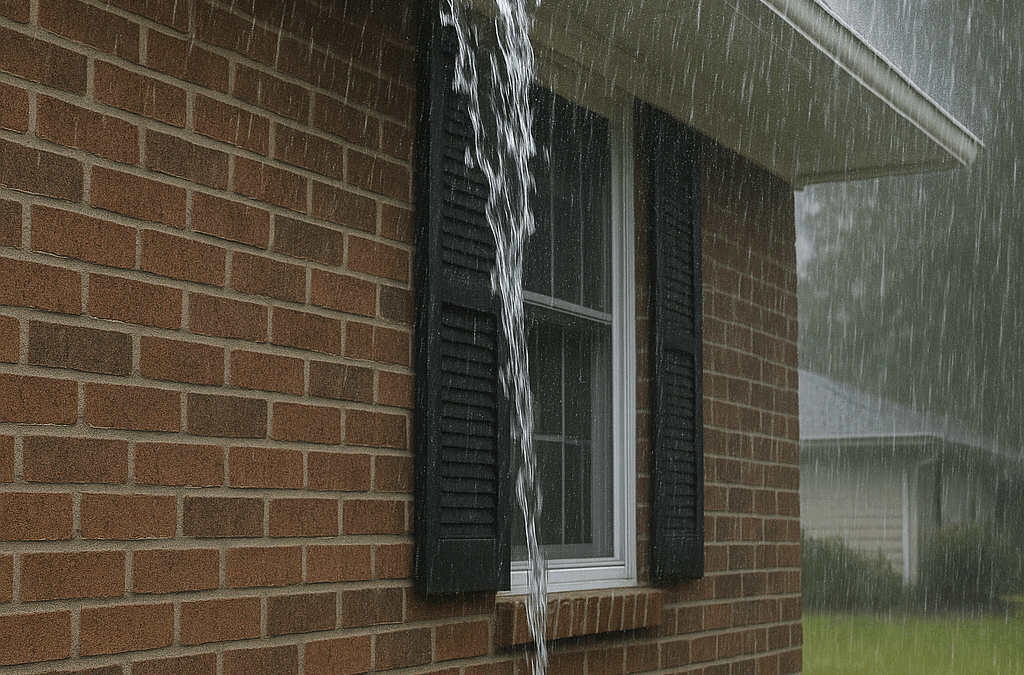
Seeing rainwater behind a gutter can be confusing. The channel may look clean, and the downspout may still be moving water, yet a separate stream appears between the gutter and the fascia. In other cases, the gutter fills during a storm and spills from both edges. Although the symptoms look similar from the yard, they can involve different parts of the roofline.
Homes between Cincinnati and Dayton include a wide range of roof shapes, ages, and exterior details. Regardless of style, standard hanging gutters depend on a clear transition from the roof edge into the channel. Drip edge or gutter apron, gutter position, fascia condition, pitch, and downspout flow can all influence whether that transition works as intended.
Why Water Does Not Always Drop Straight Into the Gutter
Water can cling to a surface as it reaches an edge. At a roof eave, properly arranged metal flashing helps encourage that runoff to move away from the roof edge and toward the gutter. Drip edge is the metal flashing at the roof perimeter, while a gutter apron may help span the space between the roof edge and gutter.
If a gap interrupts the route, water may follow the underside of the edge and reach the fascia. The effect becomes easier to see during steady or heavy rain, when a narrow drip turns into a larger stream.
The condition is not always caused by one missing part. The gutter may have shifted, the fascia may have weakened, or water may be backing up inside the channel. The visible path needs context.
Common Causes of Water Behind Standard Gutters
Roof-edge flashing does not direct water into the channel
Drip edge and gutter apron are intended to help manage the transition at the eave. If the existing flashing is damaged, separated, or not positioned to carry runoff toward the gutter, water may pass behind the channel. Roof-edge arrangements vary, so the appropriate detail depends on the house.
The gutter is too far from the roof edge
Hangers and fasteners hold a gutter in position. A loose or sagging section may create an opening large enough for runoff to miss the channel. Look for a gutter line that changes height, bows outward, or shows a wider gap in one area.
Leaves and debris are restricting drainage
Southwest Ohio’s seasonal leaf drop is an obvious source of debris, but smaller material can matter too. Seeds, twigs, roof granules, and compacted organic sediment may slow water near an outlet. A gutter that cannot drain as quickly as it fills may spill water over the back and front.
A downspout is partially obstructed
A gutter can appear relatively clean while material remains lodged at the outlet or inside the downspout. During lighter rain, some water may still pass. During a stronger storm, the restriction may cause the channel to fill and overflow.
The gutter has lost its intended pitch
Water needs to move toward a downspout rather than remain in the channel. A low spot can collect water and debris, increasing the chance of localized overflow. Puddling that remains after the weather clears is a useful sign to note.
The fascia board is moisture-damaged
The fascia finishes the roof edge and commonly supports standard hanging gutters. Recurring moisture may contribute to staining, paint failure, softened wood, or decay. If the mounting surface weakens, fasteners may loosen and the gutter may move away from its intended position.
Clues You Can Observe Without Climbing a Ladder
The safest time to examine the details closely is when conditions are dry, but observing the general water pattern from the ground during rain can also be informative. Watch for:
- Dripping directly between the gutter and fascia
- A gutter that overflows before nearby sections do
- Dark streaks or algae-like discoloration below the channel
- Peeling paint or exposed wood along the fascia
- Sagging, bowing, or a visible gap behind the gutter
- Damp or stained soffit beneath the eave
- Little or no discharge from a downspout during rainfall
- Splash marks, erosion, or staining below one roof section
Photos taken safely from the ground can help record a symptom that disappears when the weather clears. Avoid using a ladder in rain, wind, or other unsafe conditions.
Why the Location of the Water Matters
Behind an otherwise empty gutter: The roof-edge transition or position of the gutter may be involved.
Over both edges of a full gutter: Debris, downspout flow, pitch, or the volume entering that section may be contributing.
Beside a loose hanger or sagging area: Attachment and fascia condition may deserve attention together.
Below a roof valley or inside corner: Concentrated runoff may be reaching a short section of channel.
Along a long section of fascia: The flashing-to-gutter relationship may be inconsistent across the run.
These patterns are clues, not guarantees of a particular diagnosis or service.
Different Conditions Require Different Questions
Water behind a standard hanging gutter can involve several conditions. Debris-related overflow makes cleaning and drainage relevant. A gap at the eave raises questions about the drip edge, gutter apron, and gutter position. Soft or deteriorated mounting wood makes fascia condition a separate concern.
Broader condition or alignment problems may make the gutter system itself relevant. A homeowner should not assume that water behind one section automatically calls for an entirely new system. The location of the water and the condition of each component provide better information than the symptom alone.
Important Note About Box Gutters
Some older Cincinnati-area homes have box gutters built into the roof or eave rather than standard gutters hanging from the fascia. Box gutters are a different type of system and require specialized knowledge.
This article discusses standard hanging gutter systems and should not be treated as guidance for diagnosing a box-gutter concern.
Fascia Board Repair and Fascia Wrap Serve Different Purposes
It is easy to treat “fascia” as one item, but the wood and its outer covering are different components. Fascia board repair or replacement addresses the wooden material. Fascia wrap and trim metal cover the fascia exterior.
When moisture damage is visible, the condition of the wood should not be inferred from the appearance of the covering alone. Likewise, wrapping the surface should not be assumed to resolve an active drainage path behind the gutter. The source of the water and the condition of the supporting material are separate questions.
Frequently Asked Questions
Can a clean gutter still have water running behind it?
Yes. Cleaning addresses debris, but the roof-edge flashing, gutter position, pitch, and fascia condition still influence where water travels. A gutter can be clear and still fail to receive all runoff leaving the roof.
Does a drip behind the gutter mean the fascia is rotten?
Not automatically. Staining or dripping shows moisture exposure, but the condition of the wood cannot be determined from that symptom alone. Soft areas, peeling paint, loose fasteners, or changing gutter alignment may provide additional warning signs.
Are seamless gutters leak-proof?
No gutter configuration should be described as leak-proof. Seamless gutters reduce joints along straight runs, but corners, outlets, end caps, flashing transitions, pitch, and attachment still influence performance.
Can sealant fix water behind a gutter?
Sealant may be used in parts of a gutter system, but it is not a universal answer for a roof-edge gap, shifted channel, restricted downspout, or weakened fascia. Identifying the path of the water is an important first step.
Why does the issue appear only during large storms?
A partial blockage, shallow low spot, or narrow gap may handle light rainfall without a visible symptom. Faster runoff can expose a limitation that is difficult to notice during a brief shower.
Treat the Roof Edge as One Drainage Assembly
Water behind a standard gutter can involve the flashing above it, the channel itself, the fascia supporting it, or the route toward the downspout. Paying attention to when and where the water appears can help distinguish a drainage restriction from a roof-edge transition problem.